This is the investigative journalistic blog of Articolo 9 Art Consultation. Here you can find daily news and important info on the protection of artistic and cultural patrimony, criminality in the global art market, and other signifcant areas such as art markets, exhibitions, artists and cultural events.

Sunday, July 3, 2022

Articolo 9 Consulting’s Art World Reporting You Tube Channel


Il Lisippo di Fano, property of the people of Fano, Italia; currently exhibited at the Getty Villa, Pallisades Park, California. 


Articolo 9 Cosulting’s Art World Reporting YouTube Channel: Art World Investigative Journalism and Reporting. This is the investigative journalistic video channel of Articolo 9 Art Consultation. Here you can find daily news and important info on the protection of artistic and cultural patrimony, criminality in the global art market, and other signifcant areas such as art markets, exhibitions, artists and cultural events.

https://youtube.com/channel/UCaNGj_8xCYaR3p71fRwk3JQ


Thursday, April 21, 2022

Basquiat Portait in Basquiat Exhibition at NAHMAD Contrmporary, N.Y.


 Brett as a Negro, acrylic on tiling glued on plywood, painted by Jean Michel Basqiuat in 1982, in the private collection of Brett De Palma.

Back in the early 1980s, the outstanding artist Brett De Palma ran in a circle of very creative friends from the Transavanguardia, such as Jean Michel Basquiat, Francesco Clemente, Sandro Chia and Enzo Cucchi, to name only a few. In 1982, The late Jean Michel Basquiat painted this portrait of Brett and wrote the title himself. Basquiat traded the painting with De Palma for one of his artworks. The painting is currently included in the exhibit: Jean Michel Basqiuat: Art and Objecthood which is at NAHMAD Contemporary until June 6, 2022. Of the portrait, De Palma states cheerfully: “Forty years later I find myself with myself. I haven’t changed a bit.”

NAHMAD Contemporary is located at 980 Madison Avenue, New York, third floor.

Saturday, April 16, 2022

William P. Youngworth III is Suing Netflix and TriBeCa Enterprises for $2,500,000 for defamation, emotional distress and loss of consortium.


William P. Youngworth III v. Netflix and TriBeCa Enterprises


William P. Youngworth III and his son, William P. Youngworth IV, are suing Netflix, TriBeCa Productions, the Barnicle Brothers, Inc. for $2,500,000 for defamation, emotional distress and loss of consortium. This civil action arises out of damages the Youngworths feel they received after the airing of the four-part documentary series based on the infamous art robbery that occurred at the Isabella Stewart Gardner Museum in Boston on March 18, 1990 in which a Vermeer, several Rembrandts, a Manet, and drawings by Degas were stolen. This documentary film series, which is entitled This is a Robbery and first aired on April 7, 2021, has been very popular among Netflix’ subscribers, which amount to over 200 million globally. Mr. William Youngworth III believes he was wrongly misrepresented in episode 3 entitled We’ve Seen It” and states his reputation has been damaged both in his business dealings as well as his personal life. While Youngworth has had legal issues in his past, he points out that over the last two decades he has devoted his life to providing for his son and raising him well, has been an outstanding citizen in his community and has built a reputable and successful business trading in antiques.


In episode 3 of the series, ex-Boston Herald Reporter Thomas Mashberg labeled Youngworth a “petty criminal” and also stated authoritatively that he knew Youngworth stole art and antiques from a hoard of stolen art and antiques that he was safeguarding for Myles Connor while Connor was serving time in prison. Mashberg is quoted as saying

 “…in talking to this guy (Youngworth) I realized that he at some point opened up Myles’ trailor and was basically selling off items without telling Myles”. Youngworth stated that Netflix aired the accusations in episode three freely without properly vetting Mashberg or his information, which Youngworth’s lawyers point out amount to unsubstantiated personal attacks against a private citizen.


In the We’ve Seen It episode, Tom Mashberg describes the events that occurred on the night of August 18, 1997 in which Youngworth drove him to Red Hook, Brooklyn and showed him Rembrandt’s painting Storm on the Sea of Galilee, which was one of the artworks stolen from the Gardner Museum. Mashberg wrote about this sighting in the now famous We’ve Seen It article in the Boston Herald. The authorities were not satisfied and refused to grant Youngworth full immunity to produce the paintings so Mashberg requested more “proof of life.” A manilla envelope arrived with photos of the stolen art. A highly respected Gardner Museum Trustee named Arnold Hiatt was convinced Youngworth was the key to the recovery of the stolen art.


Mr. Youngworth recently told me in an interview that Tom Mashberg claimed in an article that he wrote for the March 1998 issue of Vanity Fair that Youngworth was not present when he was transported to the Red Hook warehouse and shown the Rembrandt. Now Youngworth questions why Mashberg changed the story in the Netflix series and told the interviewer that Youngworth actually drove him to Brooklyn himself and handed the painting to him after retrieving it from a tube. 


The March 1998 Vanity Fair Magazine in which Tom Mashberg describes his visit to a warehouse in Red Hook, Brooklyn.


Thomas Mashberg also received a vile with paint chips that the Boston Herald had examined by an expert named Walter McCrone. McCrone stated that "the paint chips looked like something Rembrandt plain produced. It looked exactly like the paint layers and pigments that was produced in Holland at that time. Everything was just perfect for a Rembrandt paint layer.” The paint chips were next sent to the Gardner Museum and were examined under their experts’ microscopes. The Museum officials pointed out that they saw that the color in the chips had not been used in any of the Rembrandts that were stolen from the Gardner Museum. They stated that the chips may have been from the 17th century but the colors didn’t match the colors in the paintings, so they couldn’t be from their Rembrandts. But Youngworth insists that no one ever stated the paint chips were from the Rembrandts. Mashberg points out in the episode that the color was Red Lake Madder and that pigment was used in The Concert, the painting by Vermeer that was also stolen on March 18, 1990 from the Gardner Museum. The paint chips were re-examined in 2003 by a Vermeer expert named Hubert von Sonnenburg.  Mr. Sonnenburg was the chairman of painting conservation at the Metropolitan Museum of Art in New York. Sonnenburg’s tests determined that the paint chips were an exact match for the Vermeer. In a CBS investigative reporting piece in 2015, F.B.I. Special Agent Kelly, who worked on the case out of the Boston F.B.I. Office for years, admits that the paint chips appear to be from the Vermeer.


This lawsuit, which has been filed in the Department of Trial Court in the Common Wealth of Massachusetts, is just another part of the thirty-two year long, and  complicated, drama that is the Isabella Stewart Gardner Museum art robbery saga.


View the CBS investigative reporting from 2015 in which F.B.I. Special Agent Kelly states that the paint chips appear to be from the Vermeer: 


Boston Herald Reporter Thomas Mashberg and William P. Youngworth III; oil on canvas, 2009; detail of a larger painting that is currently in art storage, by Charles Vincent Sabba.


Portrait photo of Myles Connor holding a samurai sword from his collection. This photo was taken by Charles Sabba in Myles' abode in Blackstone, Massachusetts in 2009.


Storm on the Sea of Galilee, oil on canvas, by Rembrandt van Rijn. Property of the Isabella Stewart Gardner Museum, Boston; current location is unknown.


The Concert, Oil on canvas, by Johannes Vermeer. Property of the Isabella Stewart Gardner Museum, Boston; current location is unknown.


Wednesday, March 16, 2022

Welcome to the Art. 9 Art Consultation Journalistic Blog.

Welcome to the Articolo 9 Art Consultation Journalistic blog. This news platform keeps its readers informed about current, significant art world news regarding cultural heritage protection, art theft and art crimes, art markets, art exhibitions and more. Frequent posts will be made on this blog media platform.

Occassionally, this art crimes investigative journalist team gathers.  From left to right: Jill Rackmill, Charles Vincent Sabba, Brian Ross and William P. Youngworth III. This photo was taken at the New York Athletic Association located at 180 Central Park South, New York, N.Y.
*****************************************************************
We at Art.9 Art Consulting News have a mission to bring to our readers significant art world news and are dedicated to providing thoroughly vetted stories, writings and news that has been verified as true and reliable.  We will discuss the art world and its operatives in a fair and impartial manner and will guard our reputations and honor in our reporting and work. In the State of New Jersey, a blogger is viewed as a legitimate journalist under the State's shield law and qualifies for the protections that the law provides. The judiciary considers whether or not that blogger has a connection to news media and whether his/her true purpose is to disseminate news. The judiciary also considers whether the blogger obtained his/her information through professional news gathering techniques and activities, such as talking to reliable sources, attending events, and the use of Open Public Records Acts and other similar methods used by news media organizations. The work product must prove newsworthy. 

Our previous art crimes investigative journalist team. This photo was taken at Luciano's Ristorante, Rahway, New Jersey.
***********************************************************

The State of New Jersey first adopted a reporter's privilege in 1933 and today N.J.s news reporter privilege offers some of the strongest in the nation. The N.J. Supreme Court has ruled that "the legislative intent in adopting this statute ...as seeking to protect the confidential sources of the press as well as the information so obtained by reporters and other media representatives to the greatest extent permitted by the Constitution of the United States and that of New Jersey."The definition of reporter has been given a broad definition. Because of the strong nature of New Jersey's Reporter Privilege, reporters cannot be forced to give up their sources. Subpoenas are rarely served to reporters and they are swiftly withdrawn after the reporter's lawyer invokes the privilege in writing.

Part of our mission is to protect our sources identities. This responsibility will be maintained without exception.

Portraits of former ABC Primetime Anchor Brian Ross in conversation with Jill Rackmill. Oil on canvas, detail of larger painting, 2009, Charles Vincent Sabba Jr. 
**********************************************************

Obviously, not all bloggers are considered mainstream media but journalists do blog and the protections they receive from the First Amendment and all of the various states and their supreme courts are the same as if they were reporting using traditional news platforms. There is no such thing as government licensing of journalists in the United States of America and now much of the mainstream media uses the world wide web to disseminate their news. Regarding the question of whether or not a blogger was journalist when they claim the reporter's privilege in court,  the federal appellate court crafted a test that examined the blogger/journalist's intent and the work they are performing. "We hold that the individual claiming the privilege must demonstrate, through competent evidence, the intent to use material sought, gathered or received to disseminate information to the public and that such intent existed at the inception of the news gathering prossess."  Kurt B. Opsahl is an attorney that represents the Electric Frontier Foundation, a non-profit organization that fights for the civil liberties of journalists who use the internet and other new technologies. Opsahl has stated in the past that the news media is changing and he feels it is necessary that bloggers who practice journalism should receive the protections of reporter's privilege. He was once quoted as saying "the democratization of media inherent in blogging allowing any individual with limited investment to get on that soapbox and speak to an audience of millions is adding great things to the public debate and it is critical to the free flow of information that this new form of media be able to promise confidentiality to their sources."
Portraits of investigative journalist Jill Rackmill in conversation with the late Harold Smith (fine art loss adjuster). Oil on canvas, detail of larger painting, 2009, Charles Vincent Sabba Jr.

Portraits of Billy Youngworth in conversation with Tom Mashberg, a former reporter for the Boston Herald. Oil on canvas, detail of larger painting, 2009, Charles Vincent Sabba Jr.

From left to right: Brian Ross, Charles Sabba and Jill Rackmill. 

William P. Youngworth III and Brian Ross. This photo was taken at the New York Athletic Association located at 180 Central Park South, New York, N.Y.

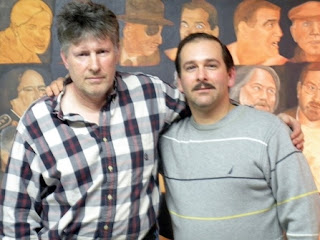
William P. Youngworth with artist/ art loss consultant/ art world investigative journalist Charles Vincent Sabba Jr.
**********************************************************
Charles Sabba aand Savona Bailey-McClain, State of the Arts NYC at the WBAI 99.5 studio in Brooklyn.

Some of my earliest reporting was coverage of the Italian Government's legal fight to recovery the Euphronious Crater and the Morgantina Silver (these art treasures were returned to Italy, the Euphronious Crater in 2008 and the Morgantina silver in 2010). I authored and published numerous articles on art crime and cultural property protection in the newspaper America Oggi, N.Y. Italy, La Voce di New York and on the Roll Call blog page of Your Brush With the Law, to name only a few.

Further reporting of mine and my colleagues has been on the Isabella Stewart Gardner Museum robbery that occurred in Boston on March 18, 1990. This will be a subject that we cover often in the future on this journalistic blog and we are dedicated to unearthing new information about the heist and the whereabouts of the stolen artworks.
Manet's Chez Tortoni, Stolen From the Gardner Museum; fingerpainted in fingerprint ink on an official police fingerprint card that was tinted with burnt siena oil paint, 2004, by Charles Vincent Sabba Jr.

William P. Youngwoth and Brian Ross, who served as Chief Investigative Correspondent for ABC News until 2018. Brian joined the Law & Crime Network in 2018 as Chief Investigative Correspondant.

Friday, August 4, 2017

Glenn Miller’s Death: Government Cover Ups Are Not New


La Voce di New York

Glenn Miller’s Death: Government Cover Ups Are Not New

Big band musician, composer, and bandleader, Glenn Miller volunteered to serve in the U.S. Army but his plane mysteriously disappeared while flying over the Enhlish Channel.

by Charles Vincent Sabba Jr


A young Phillip Gluck while serving in the U.S. Armed Forces in England

Glenn Miller.

On December 15, 1944,  Miller departed England for Paris on a small, single-engined UC-64 Norseman that was being flown by a pilot named John Morgan. He was traveling with Lt. Col. Norman Baessell but the plane disappeared while flying over the English Channel and the government blamed it on bad weather and also an issue with the plane's carburetor. He was 40 years old.
Phillip Gluck is from our greatest generation. Phillip is a WWII veteran who was born in Perth Amboy, New Jersey. His brother, Nathan Gluck, was an accomplished artist and a close friend of Andy Warhol's (in fact, Nathan was Andy Warhol's studio assistant for twenty years). Phillip has three of Nathan's art works hanging in his apartment. Both Nathan and Phillip served the U.S.A. in WWII, Nathan was a Chaplain's assistant and served in the U.S. Army in the Pacific and Phillip served in the Army Air Force from 1942 through 1945 and was a munitions handler and was stationed at Alconbury, England. 
Phillip told me: "I was fusing bombs. After the bombs were placed on the planes, I came along and put fuses on the nose and the tail of the bombs. A squadron of planes, maybe 8 to 10, would leave our base, meet up with squadrons from other bases and cross the English Channel and drop the bombs over their targets. They had to drop all of their bombs before they returned to England. Any planes with fused bombs were prohibited from landing on the bases because it was too dangerous. If they crashed while landing the whole area could blow up. So they had a designated area in the English Channel where they jettisoned any of their unused bombs prior to returning to base. All unused bombs were dropped in this designated area and there was a prohibition against private planes flying in the area."

When the famous band leader Glenn Miller was 38 years old, he was too old to be drafted, so he volunteered to serve in the U.S. Army and convinced them to let him lead an army band so he could entertain the troops. He quickly earned rank and eventually was promoted to major. He was transferred to the Army Air Forces. He was entertaining troops in France in 1944. On Dec 15, 1944,  Miller departed England for Paris on a small, single-engined UC-64 Norseman that was being flown by a pilot named John Morgan. He was traveling with Lt. Col. Norman Baessell. The plane mysteriously disappeared while flying over the English Channel and the government blamed it on bad weather and also an issue with the plane's carburetor. Miller was posthumously awarded the Bronze Star Medal.

Listening to Phillip Gluck discuss his army years is very interesting, but especially when Phillip recounted a strange story of government tough guys who appear to have been involved in a huge government cover-up and scared the life out of him when he was a young, low raking serviceman. He is very frustrated that he was forced through fear tactics to keep quiet all these years and now feels he must get someone to listen to him.  He recently attempted through his family members to inform the Glen Miller Archive but they wouldn't take him serious. About the cover-up, Phillip stated:  "Photography was my hobby, so I always hung around the photo lab. One day, I was asked to to report to the photo lab because they needed someone there to process some film. I think the usual guy who worked there was on leave or something. A reconnaissance plane had just come back with film. The reconnaissance planes would come back and have their films processed and those prints would be swiftly transported to the 8th Airforce Headquarters at High Wycombe for analysis. The film was really good prints. They were 8 by 10 contact prints and I was using a special machine with 48 lights to make them. I had the red light on outside the room which means no one should enter because the film could get ruined if they opened the door, but in this case I was almost completely done. As I was standing next to the chromium plated drum, which puts the gloss on the film, two really scary, big tough guys barged in. They were government agents dressed in suits and they barged right in and took all of the film, prints and negatives. They told me in a very threatening matter 'You never saw these!' I was a kid, only 20 or 21 at the time, and I was scared out of my wit. They told me 'you never saw these photos' but I really did see them and can't forget them. At my age, I'm 95 years old,  you forget small things in the distant past but something like this from your youth you never forget. I remember it vividly. The photos from the reconnaissance plane showed a bomber that was returning to our base dropping its bombs over the designated spot in the English channel, but right under the bomber was a small plane. That small plane shouldn't have been flying there. The bomber plane had many little bombs and it showered the small plane underneath it. A bomber can have a large bomb on it or it could be loaded with many small bombs. I think the small bombs were two hundred pounders. This plane jettisoned a whole load of small bombs on the smaller plane below it. The agents took everything. It all happened so fast. Not long after that, we all heard the news of Glenn Miller's plane disappearing. The government blamed it on a carburetor issue. But I knew it was his plane I saw in those photos. Why would they forcefully take all the photos and negatives and scare me into silence? Why would they lie? Back then they lied all the time. I guess they had to, we were at war. News of the war wasn't shared so easily like it is today."

Miller's plane was never found and he is still listed as missing in action. There is a log book of a 17 year old amateur plane spotter named Richard Anderson that surfaced years later that claims he saw Miller's plane in a different area then the restricted zone where bombers jettisoned their bombs on aborted missions. There are many different records and government findings that would dispel Phillip's claim, but logs, records and government findings in those years were easy to doctor up and manipulate. This isn't the first time this theory of RAF Lancasters returning from an aborted mission dropping their bombs on Miller's plane has been discussed, but as far as I know, it is the first time we have a living eye witness (of sorts, he saw photos). This is the first time we are hearing the testimony of a witness who experienced the fear associated with a government cover up. Was the plane that Phillip saw in the photos getting showered with bombs the same plane Glenn Miller was flying in? We can't be sure, but he is adamant there was a plane in those photos and that two government agents went to great lengths to eliminate any trace of evidence. Whether or not it was Miller's plane, it was a plane just the same; a plane with victims on board that disappeared without a trace. Phillip is certain of what he saw and is determined to share his experience with the world. He firmly believes the plane he saw in the photos was none other than the plane Glenn Miller was on and he feels it is time the truth is finally told. He has lived with this secret for 73 years now and the fact that he feels the government lied about it has eaten at his sense of justice for too long. We are living in an era of government intrigue and cover-ups, but obviously in our great Republic of the United States of America, intrigue and cover-up are not new to the political landscape.


Charles Vincent Sabba Jr

Charles Vincent Sabba Jr. is an artist who, in the past, has written articles about international art crimes and cultural property protection for US Italy and America Oggi.


Thursday, August 3, 2017

Roberto Conforti, the General who Protected the Italian Heritage, died at 79

 La Voce di New York

Roberto Conforti, the General who Protected the Italian Heritage, died at 79

He served in the Carabinieri for more than 42 years . He started his career in 1961 fighting organized crime

by Charles Vincent Sabba Jr


In 1991, He took command of the art crimes unit called the TPC (Tutela Patrimonio Culturale) until he retired in 2002. Under his command, the TPC had over three hundred carabinieri assigned to it who worked to protect the artistic patrimony of Italy. General Roberto Conforti's career was a perfect fusion of article 1 and article 9 of the Italian Constitution.

The Italian Constitution is a real masterpiece of art. Italians who love the enormous artistic riches of Italy should be proud of the protection that our constitution gives to art and cultural heritage.  Article 9 of the constitution states: “The Republic promotes the development of culture and scientific and technical research. Protect the beauty of the nation and the historic and artistic patrimony of the nation.”

On 26 July 2017, the Republic lost a commander who dedicated his life to the mission of protecting Italy’s art and cultural patrimony with all of his heart and soul. General Roberto Conforti, who passed at the age of 79 years old, served in the Carabinieri for more than forty-two years. He started his career in the Carabinieri in 1961 fighting organized crime. In 1991, he took command of the art crimes unit called the TPC (Tutela Patrimonio Culturale) until he retired in 2002. Under his command, the TPC had over three hundred carabinieri assigned to it who worked diligently to safeguard and protect the artistic and historic patrimony of Italy.  During his career, his unit recovered thousands of works of art that were stolen from private collections, galleries and museums, and churches, as well as artifacts trafficked from illicit archeological sites, and they became one of the most respected art crimes investigative units in the world.

Many Italians really appreciate Article 1 of the constitution that states that “Italy is a democratic republic, founded on work.” We can see that General Roberto Conforti’s career was a perfect fusion of both article 1 and article 9 in that his daily hard work was ardently dedicated to the protection of the artistic and cultural patrimony of Italy.


È morto Roberto Conforti, il Generale che tutelava il patrimonio dell’Italia

Scomparso all'età di 79 anni, è stato in servizio per più di 42 anni nei Carabinieri. Ha iniziato la sua carriera combattendo la criminalità organizzata

di Charles Vincent Sabba Jr
Nel 1991 ha preso comando del nucleo Tutela Patrimonio Culturale fino alla sua pensione nel 2002. Sotto il suo comando, il nucleo aveva più di trecento carabinieri assegnati che hanno lavorato diligentemente a salvaguardare e a proteggere patrimonio storico e artistico. Nella sua carriera, la perfetta fusione degli articoli 1 e 9 della Costituzione

La Costituzione italiana è un’opera d’arte. Gli italiani che amano le enormi ricchezze artistiche dovrebbero essere orgogliosi della protezione culturale che la nostra costituzione da all’arte e al patrimonio. L’articolo 9 della costituzione dichiara: “La Repubblica promuove lo sviluppo della cultura e la ricerca scientifica e tecnica. Tutela il passaggio e il patrimonio storico e artistico della nazione”. Il 26 luglio 2017, la Repubblica ha perso un comandante che ha dedicato la vita alla missione di proteggere l’arte e il patrimonio culturale dell’Italia con l’anima e il cuore: il Generale dei Carabinieri Roberto Conforti, scomparso all’età di 79 anni, è stato in servizio per più di 42 anni. Ha iniziato la sua carriera nell’arma nel 1961 combattendo la criminalità organizzata.

Nel 1991 ha preso comando del nucleo Tutela Patrimonio Culturale fino alla sua pensione nel 2002. Sotto il suo comando, il nucleo aveva più’ di trecento carabinieri assegnati che hanno lavorato diligentemente a salvaguardare e a proteggere patrimonio storico e artistico.  Durante la sua carriera, il suo nucleo ha recuperato migliaia di lavori d’arte rubati da collezioni private, gallerie e musei, e chiese, come anche artefatti trafugati da siti archeologici ed è diventato uno dei più rispettati unita di investigazione di crimini d’arte nel mondo.

Tanti Italiani apprezzano tanto l’articolo 1 della Costituzione che dichiara che “L’Italia è una Repubblica democratica, fondata su lavoro”. Vediamo nella carriera del Generale Roberto Conforti una perfetta fusione degli articoli uno e nove in cui il suo buon lavoro quotidiano era dedicato ardentemente alla protezione del patrimonio artistico e culturale dell’Italia.

https://www.lavocedinewyork.com/en/news/2017/08/03/roberto-conforti-the-general-who-protected-the-italian-heritage-died-at-79/

Thursday, August 6, 2009

John Myatt: Art Forger Turned Professional Artist. Interview by Charles Vincent Sabba

 John Myatt: Art Forger Turned Professional Artist. 

Interview by Charles Vincent Sabba.


Charles Vincent Sabba and John Myatt in Chichester, England.

The artist John Myatt was involved in what Scotland Yard described as the biggest art fraud of the 20th century. John painted over 200 fakes of artists such as Giacometti, Klee, Chagall, and Van Gogh, to name only a few. These paintings were then sold by a master con man that John was associated with. John was arrested and in 1999 served four months of a twelve month sentence. When he was released from prison he swore that he would never paint again. the Scotland Yard detective who had arrested John commissioned him to paint a family portrait. This detective, who is now retired and one of John's close friends, helped convince him to return to his easel where he belongs. He is now fast becoming one of the United Kingdom's most accomplished artists. Here John Myatt discusses his art and the art world.

John Myatt,  oil on canvas, 8" x 10", by Charles Vincent Sabba. John Myatt posed for this portrait in Chichester, England.

Charles Sabba- You had an art show in May 2006 at St. Paul's gallery in London. How did it go?

John Myatt- It was a great success! It was lovely. The gallery wants to keep the unsold paintings on a semi-permanent display. Eventually I will want to get them back though. I like to look at my old paintings with fresh eyes and possibly re-work them. 

Sabba- Tell me about your art studio.

Myatt- We have one room which is shaped like a dining room. I purposely put down an old carpet so I can get messy while I work. I go back and forth to the easels and paint gets splattered all over the floor and walls. I don't use a palette but mix my paints directly onto a table. It is rather interesting how the studio is set up. The house was built in the 1700s. When you leave my messy, worked in modern studio, you enter a very clean, old home with neat and tidy bookshelves.

Sabba- What does your studio sound like? What kind of music do you listen to when you work?

Myatt- I listen to classical music, quite often Mozart, Bach, Vivaldi, but usually Mozart.

Sabba- Would you like to share any thoughts on the contemporary art scene?

Myatt- I am not really part of that. I like to see all artists earn a living, but have no sympathy for the more challenging aspects of contemporary art. I view many of their operations as more or less stunts.  Here in the U.K., the government sponsors the arts council. Public money is spent on the arts and they are afraid to look old fashioned, so they feel they must always promote art that is cutting edge. The government needs to leave contemporary artists alone to get on with it. Good art has always been commercial, even the old masters. Artists need to make a living, but when you have a Stalinist type approval in which the government approves the art to be chosen it distorts the process entirely. The government needs to get out of the art business. The whole thing is corrupted by politicians and art experts. I'm not in the business of calling art work rubbish though. I like to see artists earning a living on their art. If they are supporting themselves on their art they are heroes.

Sabba- Have you ever visited the huge Chelsea gallery district in Manhattan? 

Myatt- We have not been to the gallery district. When we did get to New York, we spent a few days in the Metropolitan Museum of Art. My time at the Met was well spent. I spent a lot of time studying Monet's Morning on the Seine because I had received several commissions to paint this picture. I noticed that hairs from Monet's brushes had fallen off and stuck to the paint. This was also happening to me as I painted this scene and I had been painstakingly removing the brushes hairs. All in all, I like New York very much. 

Sabba- Many young artists in New York complain that Chelsea is a well greased money making machine and they believe that the conformist art world needs rebels. You certainly entered your art career on a devious path, that is to say, a less normal road traveled. Do you consider yourself a rebel? 

Myatt- In a way yes. What happened, the crime that was committed, did show that the whole system of experts and history of painting was silly and stupid. It made a lot of experts look silly. I quite like that. People are not ready to use their own eyes when looking at paintings. You do not need three years in a university before you can look at a painting and decide whether you like it or not. When you look at a fake, you feel alright saying you don't like it. Knowing that it is a fake gives you the power to say "I don't like it" or "I like it." When you look at an original painting you spend too much time reading the card on the sides, looking at the signature, listening to the audio. People think to themselves "oh, I have to go and study this artist and this painting." We have to give people the confidence to look at paintings and just enjoy them. The last thing people want is to feel stupid, so they wait for someone to tell them what art to like and dislike.

 Also, once you like an artist, you can't afford to like his paintings because the prices are too high. Money limits the choices; that is where I come in. I paint pictures that people can afford. When I paint an artist's painting, it is quite hard to tell it from an original.

Sabba- Do you get a lot of commissions from New York?

Myatt- I get some of my most astonishing commissions from New York. I think Americans are fantastic people and are a pleasure to work with. They have a nice sense of humor and I like that. What I do is funny and you have to laugh. A New Yorker recently commissioned me to paint a very large Picasso. If I painted it the size he wanted, I could have never carried it out of my studio. I told him that the painting could be no larger than 6 foot by 6 foot and he just laughed and stated "that is okay John. You do it as large as I want it and then you'll find a way."

Sabba- You have mentioned Monet several times. As far as art history goes, who is your favorite artist?

Myatt- I would have to say Pablo Picasso. He had so many different periods to look at and choose from. He changed his artistic style almost every seven years.

Sabba- That is a very interesting point. It causes great pain to contemporary artists that dealers, critics and collectors reject any change in their style. When an artist is known for his or her work, they are expected by the market to stick to it and suffer consequences if they change.

Myatt- Yes, they get trapped. It is sort of like getting stuck in prison.

Sabba- So you love Picasso. I am very enthused about the early Paris days of Montmartre and Montparnasse.

Myatt- I would have loved to have been around in Montmartre at the Bateau Lavoir. I would have loved to spend time with all those artists like Picasso, Modigliani, Braque, as well as Apollinaire and all those poets. I would have loved to be there.

Sabba- You mentioned Apollinaire. Do you have any favorite poets?

Myatt- I have not read much of Apollinaire's poetry. I like older English poets the most, such as John Donne.

Sabba- Do you have any future exhibitions in line?

Myatt- I have one scheduled for December 2007 on Dover Street in London.

Sabba- I know you have been talking to television companies. How is that playing out?

Myatt- I am a little frustrated by it all. I have a good working routine in my studio. What I do is paint. I don't produce TV shows. I've been busy with the television producers and it is taking me away from my work. When I'm not painting, I feel like I'm wasting my time. After the health and happiness of your family, the most important thing in an artist's life is his or her work.


Charles 'Vicienz' Sabba and John Myatt in Chichester, England where he posed for an oil painting and conducted an interview.

“Dr. No” the Nefarious Figure Who Commissions Art Thefts

 “Dr. No” the Nefarious Figure Who Commissions Art Thefts: Fact or Fancy? https://lavocedinewyork.com/en/arts/2023/02/11/dr-no-the-nefarious...